By Danny R. Johnson – Political News Editor
The Erosion of Trump’s Grip on the GOP
President Donald Trump’s hold on the Republican Party is finally weakening. Rather than a dramatic collapse or a theatrical downfall, Trump is being brought down by the ordinary mechanisms of politics: his popularity has waned, undermined by ongoing legal controversies—such as the recent verdict in the E. Jean Carroll case—and persistent concerns over the economy. According to a June 2025 Gallup poll, Trump’s favorability among registered Republicans has dipped below 60%, while independent voters are increasingly disapproving. These developments suggest that the political gravity which applies to most leaders now also constrains Trump, marking him as a lame duck whose influence is receding with age and circumstance.
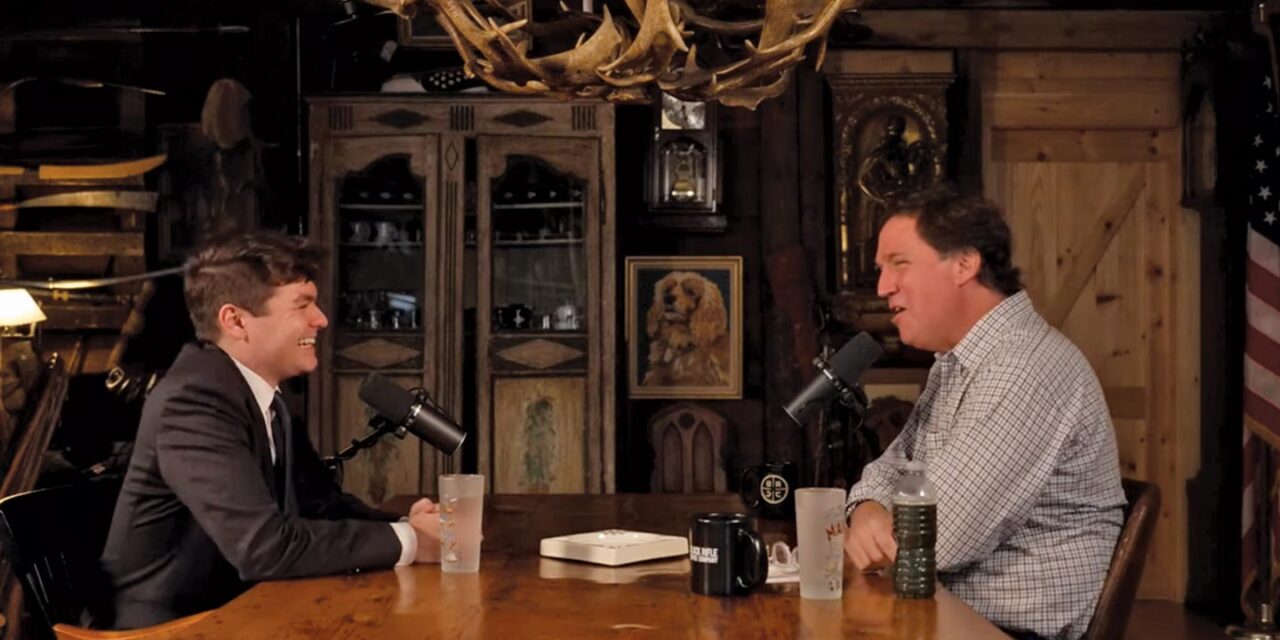
After dominating headlines for nearly a decade, Trump finds himself relegated to the background of contemporary political discourse. In this changing landscape, figures like Nick Fuentes—who has garnered attention through provocative online broadcasts and organizing events such as the America First Political Action Conference—seek to fill the void. Fuentes and his supporters, often referred to as “groypers,” are amplifying their presence, echoing the defiant chorus from the musical Cabaret with the refrain “Tomorrow Belongs to Me,” signaling their vision for the GOP’s future.
Alliances and Strategic Moves Within the Party
Vice President JD Vance and provocative commentator Tucker Carlson appears to be aligning themselves with Fuentes and the groypers. Carlson is actively welcoming Fuentes and his faction, providing them with a platform to spread their message. Meanwhile, Vance is careful not to criticize them, instead lamenting internal divisions within the party. He urges others to redirect their animosity toward groups he alleges are monopolizing housing and social-welfare benefits. This approach reflects the shifting priorities and alliances forming within the GOP as the party navigates a period of significant transition.
Recent developments illustrate a complex and evolving dynamic within the GOP, as the diminishing influence of Trump creates opportunities for figures such as Fuentes to gain prominence. The interaction between significant changes in leadership and the strategic actions of emerging voices highlights the current volatility and unpredictability within Republican politics. As the party addresses these challenges, the forthcoming months will be pivotal in determining the guiding vision for its future direction.
Vance’s position is particularly humiliating and low: As Fuentes and the groypers call him “fat boy,” and his Indian American wife, Vance, holds his fire. He apparently thinks he cannot afford to alienate the white-nationalist caucus that he views as integral to his likely 2028 bid for the White House. Vance is in a tricky spot: He’s trying to cultivate the extreme right, but he’s also the candidate closest to Peter Thiel and the tech-bro contingent.
The Changing Landscape of Political Discourse
And for reasons both populist and antisemitic, Fuentes detests the ascendancy of the tech oligarchs in the GOP. “Most of them are immigrants, most of them are either brown or Jewish, many of them are gay, and all of them are non-Christian,” he wrote on, in a text that also advises: “YOU FORGOT THE NUMBER ONE RULE OF POLITICS: DETERMINE WHETHER THEY ARE JEWISH.” And until now, they’ve also stood in the way of Fuentes’s bid to storm the commanding heights of the Republican Party. Fuentes may not have much use for the tech oligarchs, but they clearly view him and his followers as applicable in some way.
Remember, it was Elon Musk who allowed Fuentes and the other creepy-crawlies back inside when he all but extinguished content moderation on X. To understand why, it helps to remember the political functions of antisemitism. One is its deployment as a tool in a factional battle for control over a political party. Think Stalin versus Trotsky: Present the other guys as alien interlopers, the puppets of foreign and unseen powers. We can see that tactic clearly in Fuentes’s campaign to take over the GOP. But another key use of authoritarian antisemitism is to create a coalition of the top and the bottom— an alliance of the elite and the mob.
As Benjamin Ginsberg writes in his neglected book, antisemitic appeals “are used by forces that attempt to mobilize the masses while avoiding threats to the interests and property of elite strata. Thus, anti-Semitic ideologies are typically espoused either by radical populists who court elite support or by a segment of the upper class seeking to arouse and mobilize a mass base for an assault on the established order.” Now, who might want to manipulate the masses without serious threats to their interests or property? Maybe the industrialists who wish to seize the state and raid its coffers for their high-tech armaments business?
Fuentes, too, might be clever enough to modulate antisemitism when it suits his ascent. He, “We’ve reached a stage in the adoption of antisemitism…where now it actually might be time to start to refine. Because now it’s just attracting a lot of idiots, and…I will not be held hostage by idiots that don’t know what they’re talking about.” So maybe Fuentes will now decide who a Jew.
Fascist movements typically consist of both populist agitators and members of the class ownership who believe they can control these groups. This alliance is risky: the agitators may turn against their sponsors, while leaders may eliminate those who threaten their authority. Fuentes should note what happened to Ernst Röhm and other brownshirt figures.