By SDCN Staff
Mexicali, Baja California–Sixty-five years after it opened its doors just south of California, CETYS University has earned a distinction no Mexican university had before: a formal Proclamation from San Diego County.
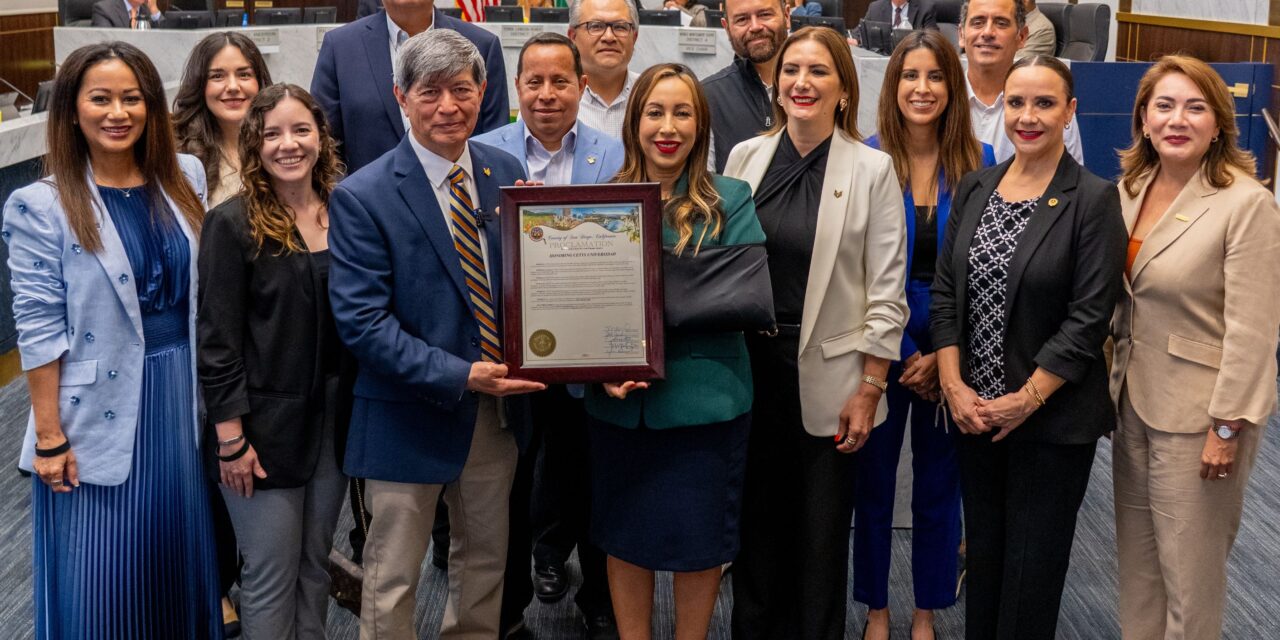
On Sept. 15, the Board of Supervisors presented CETYS with the “CETYS Day Proclamation,” recognizing the university’s contribution to the community and to collaboration on both sides of the border.
The recognition comes at a pivotal moment. U.S.-Mexico relations face new challenges, and with them, new opportunities for institutions that can connect education to the needs of a binational economy.
CETYS now counts more than 8,000 students, nearly 55,000 alumni, and more than 1,000 faculty members. Its strategic position on the border with California, one of the world’s largest and most dynamic economies, has shaped its evolution. Today the university maintains more than 100 academic partnerships in over 30 countries, along with mobility programs and collaborative projects with institutions, companies, and organizations in Mexico, the United States, and beyond.
“More than six decades ago, CETYS was born from the dream and vision of the Baja California community: to educate young people with talent, character, and a global outlook. It is a project that, thanks to the commitment of leaders and business people, has transformed lives and entire regions. It has developed systematically, expanding its impact, coverage, reach, and significance. CETYS’ calling is the teaching of science and the comprehensive education of people,” said Dr. Fernando León García, president of the CETYS University System.
The university holds institutional accreditation from the Western Association of Schools and Colleges (WASC), the first university in Mexico and Latin America to earn it.
“WASC does not accredit only institutions in the United States; we accredit institutions around the world. In the United States, we recognize them as leaders in innovation and educational success, and when we talk with other institutions about accreditation, we often speak of CETYS as an example and a benchmark for how an institution decides to develop,” said Dr. Maria Toyoda, president and CEO of the WASC Senior College and University Commission.
That U.S. connection took physical form earlier this year. The CaliBaja Innovation Center, developed by CETYS together with the US Consulate General in Tijuana, opened in the first half of 2026. It reflects collaboration among the US Embassy, educational institutions, and the private sector to expand opportunity and strengthen ties.
The CaliBaja Innovation Center is part of a network of nearly 600 American Spaces in more than 140 countries, including nine in Mexico, all affiliated with the US Department of State. It is the first of its kind in the entire Baja California peninsula and northwestern Mexico.
In June, CETYS formalized an agreement with Southwestern College in California to strengthen academic mobility and develop joint programs. That same month, it signed a Memorandum of Understanding with the Universidad Católica del Uruguay to expand student and faculty exchange and deepen its ties across Latin America.
During the summer of 2026 alone, 215 CETYS students took part in academic experiences with City University of Seattle in the Czech Republic, the United States, and Germany. The International Summer Program brought together 283 students and faculty from 18 countries at CETYS’s Ensenada International Campus.
Over the last school year, CETYS high school, undergraduate, and graduate students logged more than 1,500 international experiences, and 74% of bachelor’s degree graduates had at least one international experience during their studies. For the university, the goal goes beyond mobility: it is about building a global perspective into the college experience itself.
“We celebrate our progress and achievements. We renew our commitment to creating educational experiences that make a meaningful impact on society, within and beyond our borders. We proudly reaffirm ourselves as an institution that transforms the lives of our students with a global vision and a deep sense of responsibility toward our surroundings,” said Dr. León García in his institutional message for the anniversary.
CETYS is also preparing to relaunch its Institute of Ibero-American Studies and its Asia-Pacific Institute, expanding research, exchange, and academic dialogue with regions around the world.
The 65th anniversary comes as the U.S.-Mexico relationship once again puts talent, education, and cross-border collaboration at the center of the conversation. For CETYS, the answer lies in stronger links among universities, industry, governments, and communities.
“The future of CaliBaja cannot be built in isolation. It requires talent that understands both sides of the border, institutions able to collaborate, and a shared vision for development,” said León García.
That outlook will shape the anniversary agenda, which includes academic activities, international gatherings, and community dialogue in Mexicali, Tijuana, and Ensenada, as well as San Diego.