By Danny R. Johnson – Political News Editor
With protests mounting across the country to stop Donald Trump and the Republican Party’s militarization of the Immigration Customs Enforcement, their unconstitutional anti-immigrant policies, and the assault on working-class people, many pundits invoke Dr. Martin Luther King Jr.’s nonviolent strategies and the civil rights movement on the “right ways” to protest. And yet, most distort the substance of what Dr. King did and believed. Here are five lessons on MLK Day 2026:
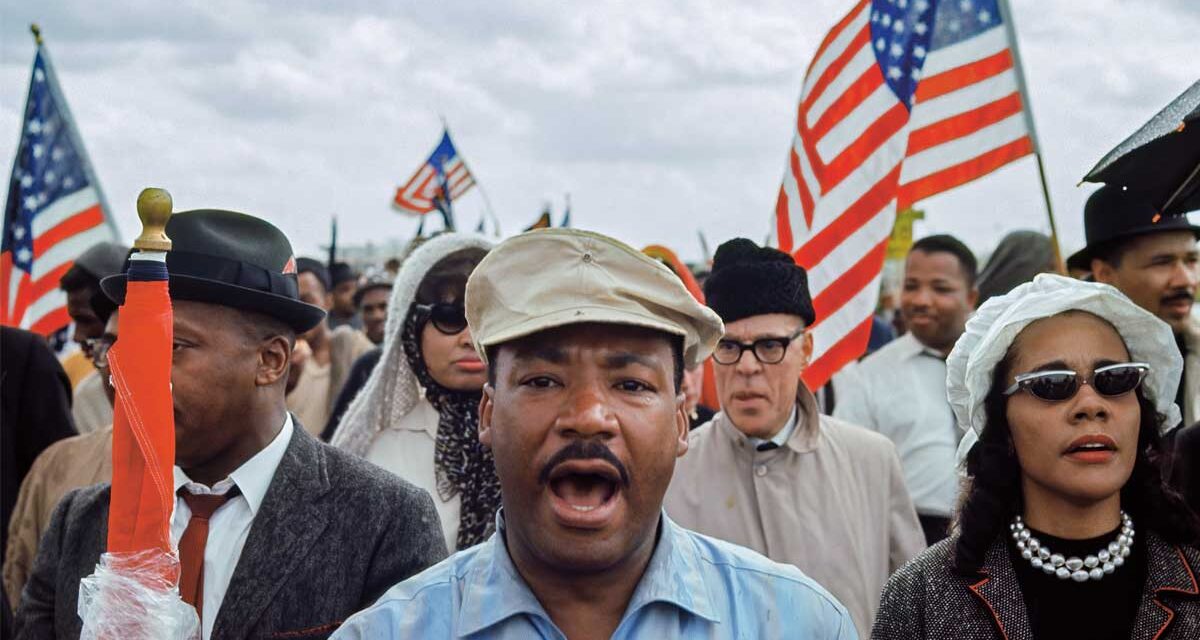
Dr. King faced fear and insecurity in police encounters from Montgomery to Memphis, but persevered. At the initial Montgomery meeting, when other ministers were reluctant to speak, 26-year-old Dr. King volunteered despite his apprehension. Eight weeks later, his residence was bombed with his wife, Coretta, and their infant daughter inside; Coretta managed to ensure their safety. Despite family members’ urging them to leave Montgomery, Coretta declined. Both Dr. King and Coretta King demonstrated remarkable resolve, continuing their efforts despite adversity and societal obstacles. Dr. King encountered repeated incidents of police brutality—he was arrested twenty-nine times and subjected to various forms of mistreatment. He criticized the heightened presence of law enforcement in Black communities, particularly during protests, and asserted that some Americans sought democracy solely for whites, perpetuating a form of authoritarian control over Black Americans, as expressed at a 1967 Atlanta gathering.
Coretta Scott King was his political partner. When Coretta Scott met Martin Luther King, Jr., in graduate school in Boston, she was already an active political figure—more so than he was at the time. While attending Antioch, she supported the Progressive Party’s 1948 presidential campaign, taking a stand against segregation and Cold War militarism and backing candidate Henry Wallace. Her activism brought her into contact with influential figures like Paul Robeson and Bayard Rustin before she even met Dr. King. He was immediately impressed by her activist spirit and intellect, which inspired him to become more engaged in political action, while she was drawn to his vision and resolve. Coretta later explained that Dr. King always encouraged her to be herself, allowing her to voice her own opinions. She became the family’s leader on global peace issues and openly opposed the Vietnam War before Dr. King did. In 1965, when Coretta spoke at a major anti-war rally at Madison Square Garden, a reporter asked if Dr. King had influenced her. He answered, “No, she educated me.”
The Movement extended beyond merely determining effective strategies; exposing injustice remained imperative. Dr. King’s leadership demonstrated that prevailing social conditions were morally unacceptable, emphasized the agency of every individual, and underscored the necessity of action regardless of immediate success. During a radio broadcast, a Chicago student who had been arrested the previous year for protesting school segregation asked Dr. King whether any tangible progress had been made, citing her peers’ skepticism and perceived greater achievements in the South. Dr. King addressed her concerns sincerely and reinforced the significance of challenging injustice:
“You have indeed accomplished something, and I encourage you not to be discouraged. If the movement had not taken place last summer, conditions within the schools would persist without scrutiny or opposition. Frequently, you are affecting more change than may be immediately apparent, as you are central to the issue. Many advancements we now pursue are possible because last summer’s efforts established an environment conducive to building a robust movement aimed at ending discrimination, injustice, poverty, and substandard living conditions in Chicago.”
Dr. King welcomed all, regardless of appearance or etiquette. He believed that everybody had something to contribute. In Chicago, he spent countless hours collaborating with gang members, recognizing their potential as leaders. The mutual respect between Dr. King and these young men is evident—even if they disagreed at times. Lawrence Johnson of the Vice Lords said, “You couldn’t help but fall in love with him,” while Jeff Fort of the Blackstone Rangers emphasized that Dr. King recognized the value of street organizations and always listened closely to them. Yet most people only remember Dr. King giving speeches, overlooking his powerful ability to listen.
City officials, the media, and even some members of Dr. King’s own Southern Christian Leadership Conference criticized his work with gangs, calling them “gangbangers.” Despite this, Dr. King persisted. decried the tendency “of looking sympathetically at all sides that it fails to become committed to either side.” In June 1966, Dr. King and the SCLC organized the Turfmasters First Annual Conference, bringing together two hundred gang members from eighteen different Chicago gangs—including Black, white, Native American, Mexican, and Puerto Rican groups. Their goal was to stop gang violence and focus on advocating for community needs. These gang members became marshals during the summer 1966 marches to challenge Chicago’s sundown neighborhoods. Facing intense white violence, they stayed peaceful—even catching thrown rocks and bottles with baseball mitts. Later, they travelled to Washington, DC, in 1968 to continue the Poor People’s Campaign that Dr. King had begun before his assassination.
Dr. King advocated for constructive disruption. Dr. King’s philosophy of non-violence extended beyond peaceful marches and sit-ins to include school boycotts, rent strikes, and other actions intended to interrupt daily life, as he recognized that injustice persisted due to widespread complacency. In 1960, Dr. King collaborated with Bayard Rustin and A. Phillip Randolph to organize a March on the Conventions, aiming to hold both the Democratic and Republican parties accountable to Black interests. This approach drew objections from Representative Adam Clayton Powell and NAACP leader Roy Wilkins, who opposed targeting the Democratic Party; nevertheless, Dr. King and his colleagues proceeded with their plan.
During the winter of 1964, Brooklyn CORE initiated a stall-in on highways leading to the World’s Fair in New York City to draw attention to persistent inequalities within the city. After years of protesting school segregation, housing discrimination, and employment inequities without meaningful results, they articulated an apparent demand: “We want jobs now, integrated quality education, [and an] end [to] slum housing.” The proposal incited strong opposition from municipal leaders and many moderate advocates, both Black and white, who pressured Dr. King to condemn the demonstration. Dr. King declined, stating, “We do not need allies who are more devoted to order than to justice.” He acknowledged criticism regarding direct-action tactics alienating former supporters, asserting, “If our direct-action programs alienate so-called friends…they never were really our friends.” Dr. King also rejected admonishments that discouraged expressions of legitimate anger among Black citizens, emphasizing that “mass civil disobedience can use rage as a constructive and creative force.” He argued it was unreasonable to demand restraint when such outrage was justified.
Major newspapers like The New York Times and The Washington Post, known for their clear and rigorous coverage of Southern movements, often portrayed Northern activists—including Dr. King—who confronted segregation and police misconduct in their own regions as “unreasonable,” “dangerous,” or “self-defeating.” Northern politicians and editors who previously commended Dr. King when his focus was limited to the South labeled him an outside agitator. They said his advocacy was unwelcome when he addressed injustices in their areas. The media routinely characterized nonviolent protest actions, such as the stall-in and the 1964 New York City school boycott, as “violent,” despite the absence of harm to people or property.
The civil rights movement offers valuable lessons for contemporary progress: Although the outcomes are uncertain, it is imperative to take action; participation is required from all members of society; and, as with Dr. King’s tactics, current efforts may be criticized as unreasonable, violent, or self-defeating—yet persistence remains essential. These insights can only inform our actions if we engage with the authentic history of Martin Luther King Jr.’s nonviolent approach, rather than the distorted version Trumpism wants us to believe.