
By Danny R. Johnson – Jazz and Pop Music Critic
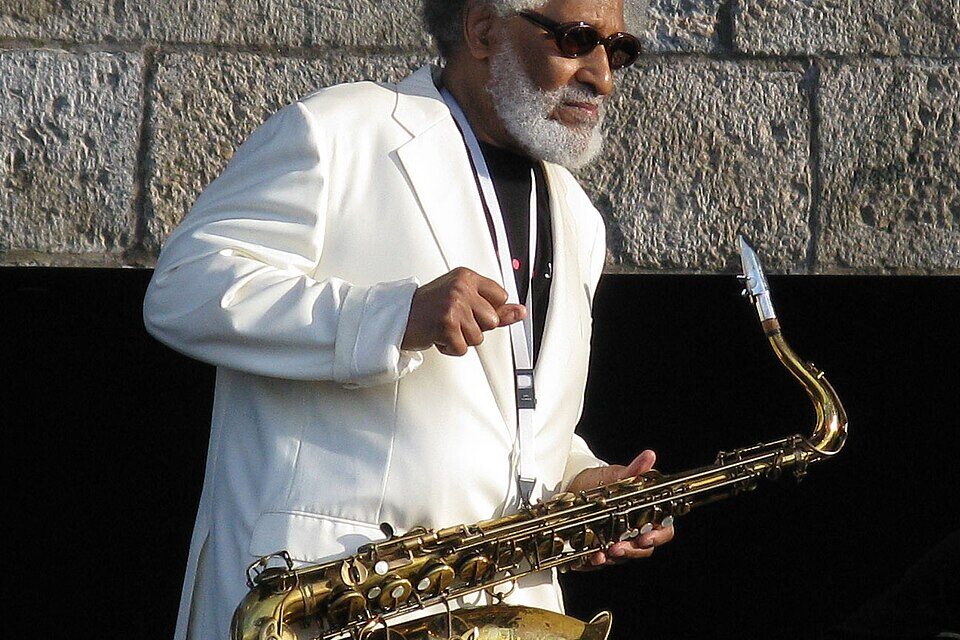
Sonny Rollins stands as one of the towering figures in jazz history, a musician whose sound, imagination, and discipline reshaped what the tenor saxophone could express.
Across a career that spanned more than six decades, he combined technical brilliance with fearless improvisation, creating performances that felt both deeply rooted in tradition and thrillingly alive in the moment. His passing at age 95 on May 25, 2026, prompted tributes that recognized not only his virtuosity but also the rare integrity and independence that defined his musical life.
Listening in my office to WPFW 89.3 FM’s Sunday tribute to Sonny Rollins, I am reminded once again of the extraordinary genius he brought to jazz.
The last time I saw Rollins perform was at the 1997 New Orleans Jazz and Heritage Festival. Nearing his 77th birthday that fall, he showed no sign—apart from a whitening beard—of any decline in physical or mental strength.
One of the last jazz immortals to emerge in the mid-1940s, Rollins remained a towering presence throughout his 60-year career. He will be remembered as a daring, original visionary whose rare performances and recordings inspired extraordinary anticipation and passionate debate.
Breakthrough Recordings and Signature Works
In 1955, Rollins recorded his first 12-inch LP as a quartet leader, “Work Time.” He opened with a crisp countdown and launched, improbably but brilliantly, into “There’s No Business Like Show Business,” then closed with a measured reading of “There Are Such Things” capped by a stately cadenza. Yet “Work Time” was only the beginning. Within four months, he appeared as the nominal leader of the Clifford Brown-Max Roach Quintet on “Sonny Rollins Plus Four,” revealing even greater agility, authority, and a continued flair for reimagining popular songs. Weeks later, he faced the then little-known John Coltrane on “Tenor Madness.” Rollins was only beginning his ascent.
A few months later, Rollins assembled another quartet to record “Saxophone Colossus,” an album that not only confirmed his astonishing level of play but also drew a widely read review from Pulitzer Prize-winning composer, conductor, jazz historian, and educator Gunther Schuller. Schuller’s use of the phrase “thematic improvisation” helped define Rollins’s art and cement the album’s standing as a classic.
By then, Rollins was already viewed as the most important tenor saxophonist to emerge after Dexter Gordon and Stan Getz and, by many, the most influential since Coleman Hawkins and Lester Young. He had become a favorite of critics as well as a commanding force in jazz.
For me, Sonny Rollins was more than a giant of the tenor saxophone; he was a model of artistic courage, discipline, and lifelong striving. He could turn a standard into a revelation, make a calypso swing with joy and authority, and improvise with a freedom that always remained rooted in deep musical wisdom. From “Saxophone Colossus” and “Tenor Madness” to the hard-won rebirth of “The Bridge,” his career showed that greatness is not simply talent, but the relentless pursuit of truth in one’s art. Sonny Rollins leaves behind more than classic recordings—he leaves an example of integrity, imagination, and fearless self-renewal that will continue to inspire musicians, critics, and listeners for generations.