By Danny R. Johnson – Jazz and Pop Music Critic
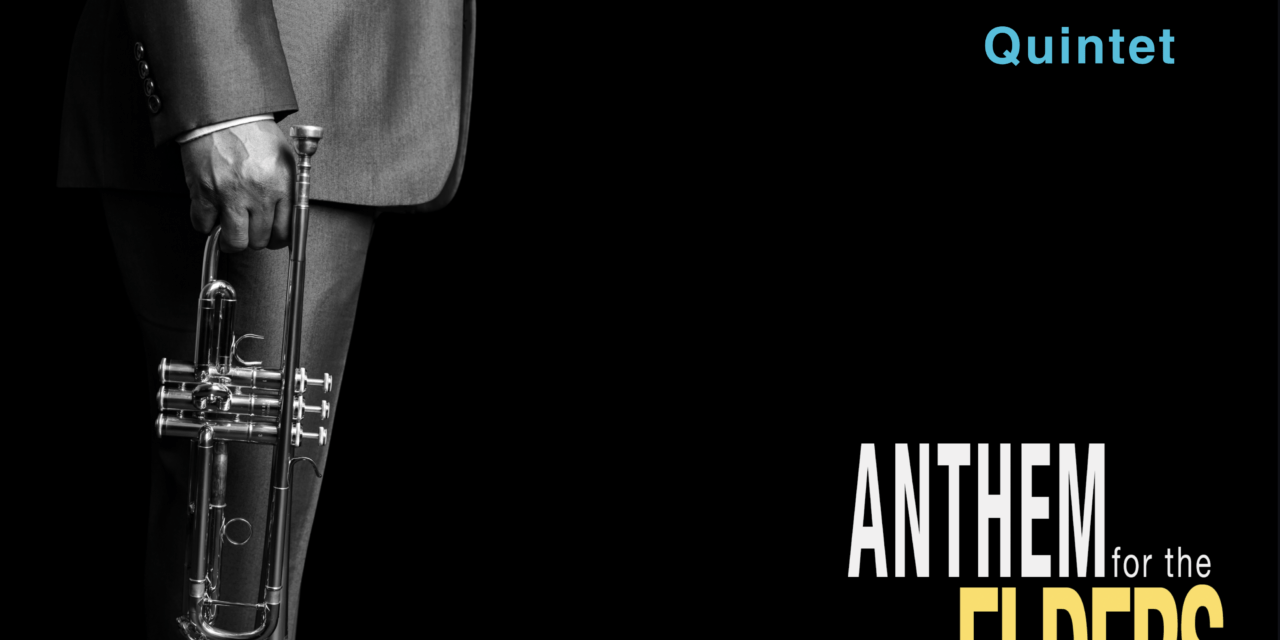
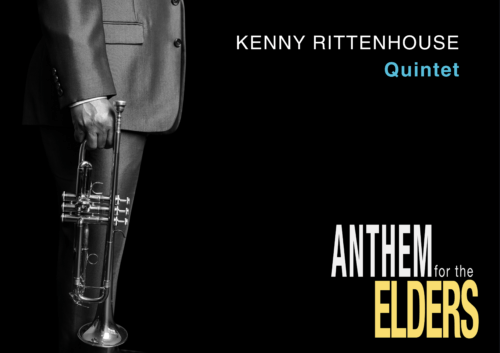
For much of its history, jazz has won devoted listeners through the promise of inexhaustible excitement: throbbing rhythms, piercing high notes, volatile polyphony, layered riffs, dazzling virtuosity, fevered exchanges, and earthy funk. That spirit comes vividly to life in the competitive drive of the Kenny Rittenhouse Quintet and its new album, Anthem for the Elders.
Kenny Rittenhouse, a Washington, DC trumpeter known for his bright tone and lyrical phrasing, is often compared to Freddie Hubbard. Released June 12, 2026, on Kaela Records, Anthem for the Elders is his third album as a leader, after The Francis Suite (2006) and New York Suite (2013).
Rittenhouse has lived in Washington, DC, for 36 years, since joining the U.S. Army Blues in 1990, where he spent 30 years as a full-time staff musician. He remains active with the Smithsonian Jazz Masterworks Orchestra, has toured internationally with artists such as Hubert Laws and Kurt Elling, performs with the Strathmore Jazz Orchestra and DC All-Stars Big Band, and teaches trumpet at American University. He is also director of the Bethesda Blues & Jazz Youth Orchestra, a role he took on in 2019 following the passing of founding leader Fred Foss, and a 2025–26 DC Commission on the Arts and Humanities Fellow — a grant that helped fund the recording of Anthem for the Elders.
The band consists of cats who are the most talented and swinging musicians: Kenny Rittenhouse on trumpet, Tim Green on alto saxophone, Allyn Johnson on piano, Kris Funn on bass, and Carroll “CV” Dashiell III on drums; it blends themes of community, revolution, and remembrance, honoring the vitality, struggle, and spirit of the Black experience. The music pays tribute to the elders who opened doors and to the traditions that continue to shape generations. Through the language of modern jazz, it moves through heritage, hope, and transformation.
The ability to place his notes in unexpected places is Kenny’s strongest virtue. It colors his work throughout the nine tracks Anthem for the Elders album.
On the Anthem for the Elders track, Johnson builds his solo by moving between bluesy lines and more florid bitonal explorations, letting each idea flow naturally into the next. A few chromatic descending chords flesh out the blues changes and keep the harmony in motion. Several choruses in, he shifts to a more pointed attack, using barbed single-note repetitions that lead cleanly into his entrance and the bass solo that follows.
The “Tamir” track honors Tamir Rice, the 12-year-old Black child killed by police in 2014 while playing in a Cleveland, Ohio, park. Kenny reflected on the piece with deep solemnity: “I thought about my own five-year-old son at the time and the world he would have to navigate as a Black boy in this country.”
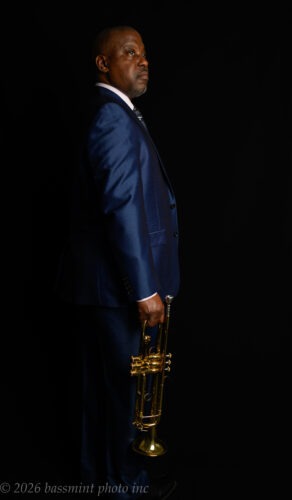
Kenny opens “Tamir” at a snail’s pace, moving through metric shifts that range from rubato to a slowly swinging long meter. The space between beats stretches so wide that the rhythm players sometimes sound like a council of kibitzers, filling the gaps with everything except the obvious choice—a backbeat, which is at times appropriately muted. Kenny remains out front for nearly half the performance, shaping several deeply personal opening choruses skillfully using his cup mute before returning at the bridge of pianist Johnson’s inspired improvisation. It is a stunning, deeply moving tribute to Tamir.
To hear the band’s virtuosity, start with “Good Evening Mr. Brown” and “Baltimore.” Both tracks leave room for open space, jagged lines, and simple melodies often voiced in unison by Kenny and Tim Green’s superb alto saxophone. Carroll Dashiell drives the music with forceful drumming, while the horns often move with little or only a modest pulse. Frequent rhythmic shifts create moments with almost no fixed meter. The piano functions largely as a solo voice, giving the horns wide harmonic freedom. At times, the whole band digs into a heavier groove, with Kenny swinging in the spirit of Miles Davis and Freddie Hubbard.
Bassists of the 1940s, including Oscar Pettiford, Ray Brown, and Charles Mingus, embraced Bebop’s new freedom and elevated the bass’s technical and musical possibilities. By the late 1950s and 1960s, Scott LaFaro, Ron Carter, and Charlie Haden pushed rhythm-section playing even further, each pursuing a distinct musical vision. Kris Funn stands as a beneficiary of those innovations handed down by the elders.
Anthem for the Elders would be incomplete without bassist Kris Funn’s mastery. Across the album, Funn displays dazzling command of Bebop bass, drawing on techniques shaped by elders such as Ray Brown, Oscar Pettiford, Wilbur Ware, and Paul Chambers. His lines feel organic, not theoretical—the result of deep practice made instinctive. That is the secret to great bass improvisation: learn the theory, master the scales and arpeggios, let the elders’ spirit guide you, then trust your ears and play. Bravo, Brother Funn!
Click on the link for additional information on the Kenny Rittenhouse Quintet and how to purchase Anthem for the Elders: https://www.kennyrittenhouse.com/newalbum