By Danny R. Johnson – World Music/Pop Music Critic
D’Angelo, the renowned neo-soul artist known for revitalizing 1970s R&B in the 1990s and early 2000s with his innovative style, passed away on October 14 at the age of 51. His career included widespread recognition following a notable music video, after which he took an extended hiatus from the public eye.
His death was confirmed in a statement by his family, which did not say where he died but gave the cause as succumbing to pancreatic cancer.
In the early stage of his career, culminating with the success of the 2000 album “Voodoo,” D’Angelo emerged as a prominent figure in the evolution of soul music. He integrated the melodic sensibilities of classic vocalists such as Al Green and Marvin Gaye with the rhythmic elements and intensity characteristic of hip-hop.
His biggest songs, like “Lady,” “Brown Sugar,” and “Untitled (How Does It Feel),” were hailed as supreme examples of the trend, which sought not a revival of Black pop traditions but a transformation of them. Each of those tracks became a Top 10 hit on Billboard’s R&B chart, D’Angelo went into heavy rotation on Black radio stations, and “Lady” went to No. 10 on Billboard’s all-genre Hot 100 chart.
D’Angelo’s signature vocal style was a delicately expressive falsetto that, like Prince’s, could build to an ecstatic wail. Like Prince, he also arranged his music meticulously, served as his own producer, and played guitar. Critics exalted him as a worthy successor to the greatest traditions of Black pop. “He is R&B Jesus, and I’m a believer,” Robert Christgau wrote in The Village Voice in 2000.
“Untitled,” which unfolds slowly, at an erotic tempo — it runs to more than seven minutes in its full album version — also crossed over to the broader pop market, thanks in no small part to its music video.
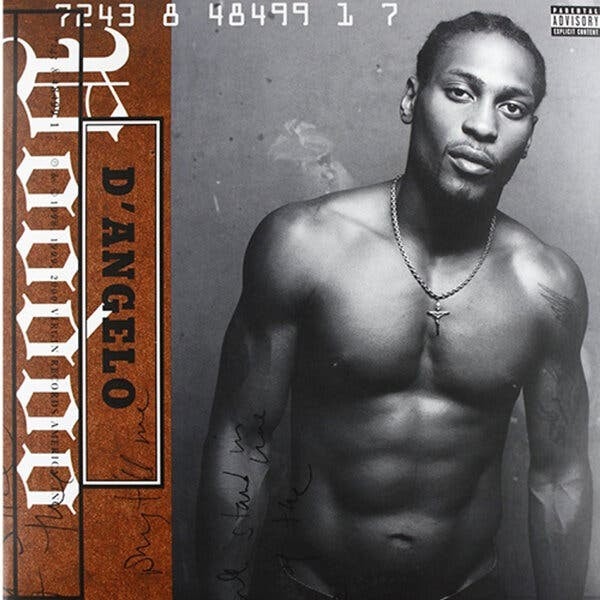
In the video, D’Angelo stood against a dark backdrop as a Black Adonis in cornrows, apparently naked except for a gold chain with a crucifix. (The video framed its lower edge just below his waist.) The camera slowly scanned his muscled, sweat-drenched physique as he brought the song to an orgasmic climax.
The video established D’Angelo as an unabashed sex symbol — The New York Times called it “pure beefcake” — and bolstered his commercial power, sending “Voodoo,” the album that the song appeared on, to No. 1 for two weeks.
In 2001, “Voodoo” won best R&B album at the Grammys, and “Untitled” took best male R&B vocal performance.
But D’Angelo, the son of a Pentecostal minister who sometimes described his art in spiritual terms, grew uncomfortable with being pigeonholed as a heartthrob. After a breakdown on tour, he fell into a depression and struggled with alcohol and drug abuse before going to rehab.
“‘Untitled’ wasn’t supposed to be his mission statement for ‘Voodoo,'” his former manager, Dominique Trenier, told Spin magazine in 2008.
“I’m glad the video did what it did,” Mr. Trenier added, “but he and I were both disappointed because, to this day, in the general populace’s memory, he’s the naked dude.”
D’Angelo also chafed at the description of his music as simply neo-soul. “I never claimed I do neo-soul,” he said in a Red Bull Music Academy interview in 2014. “When I first came out, I used always to say: ‘I do Black music. I make Black music.’”
For much of the rest of his career, D’Angelo would vanish from the public eye for years at a time. After “Voodoo,” he did not release another album until “Black Messiah,” which he produced himself, in 2014. That album brought two more Grammys.
His absences further cultivated his mystique among his fans and drew concern. In May, he withdrew from a festival performance in Philadelphia, citing a recent surgery.
Michael Eugene Archer, known professionally as D’Angelo, was born in South Richmond, Virginia, on February 11, 1974. His father served as a Pentecostal preacher, while his mother worked as a legal secretary. During his childhood, he played the organ and participated in the choir at his father’s church. He further broadened his musical experience by exploring his uncle’s diverse record collection and engaging in brief classical music studies.
After relocating to Chesterfield, Virginia, for high school, Archer formed a hip-hop group called IDU (Intelligent, Deadly but Unique) with friends and performed at talent shows. At age sixteen, after securing victory in a local contest, he travelled to New York to compete in Amateur Night at the Apollo Theater, ultimately winning with his rendition of Johnny Gill’s “Rub You the Right Way.”
Archer later returned to New York in pursuit of a recording contract, auditioning for a music publisher with performances of songs by Jodeci, Miles Davis, and a gospel selection—reflecting the varied influences that would shape his future work. By his late teens, he adopted the stage name D’Angelo, reportedly inspired by the artist Michelangelo.
He signed with EMI, and his first album, “Brown Sugar” (1995), established a musical style characterized by complex arrangements and layered vocals, all performed by D’Angelo. The album incorporated influences from Prince, traditional soul, and gospel music.
The album’s title track and “Lady” contributed to its steady rise in popularity, reaching No. 4 on Billboard’s R&B chart and No. 22 on the Billboard 200 chart; it achieved platinum status within a year.
For the follow-up to “Brown Sugar,” D’Angelo worked with several collaborators, including drummer and producer Questlove, keyboardist James Poyser, and hip-hop producer J Dilla. This group, known as the Soulquarians, occasionally included Erykah Badu, Common, and Mos Def. They recorded at Electric Lady Studios in Greenwich Village, sometimes spending as much time listening to music as recording.
“The best way to describe the process is very much like a sculpture,” he once told Rolling Stone. “You’re just constantly chipping and chipping away at it. I’ll work on something for a minute, and, once I feel like I’m starting to fixate on it, I put it away and go to another one.”
At the same time, D’Angelo was becoming a bona fide celebrity. According to a profile in GQ Magazine published in 2014, Madonna invited him to sing “Happy Birthday” to her at her 39th birthday party in 1997.
While recording “Brown Sugar,” D’Angelo became romantically involved with the soul singer Angie Stone. In 1998, they had a son together, Michael D’Angelo Archer II, also known as Swayvo Twain.
D’Angelo had two other children, but complete information about his survivors was not immediately available. Stone, who was also an early rap pioneer, died in a car crash in March at 63.
The making of “Voodoo” stretched on for nearly two years in the studio. When released, it was received as a triumph. According to GQ, George Clinton, the funk icon behind the groups Parliament and Funkadelic, compared the album to Gaye’s 1971 landmark album “What’s Going On.”
In the troubled wake of “Voodoo,” D’Angelo decamped to Richmond. In 2005, he was given a three-year suspended sentence for cocaine possession, and that same year, he crashed his Hummer on a road near Richmond, breaking his ribs. He returned to performing in 2012, though he was no longer the svelte, muscular figure of his “Voodoo” days.
“Black Messiah,” credited to D’Angelo and the Vanguard, was made with a team of collaborators that included Questlove, the jazz trumpeter Roy Hargrove, and the stalwart R&B drummer James Gadson. In a review in The New York Times, Jon Pareles and Jon Caramanica called it “a knotty, inward-looking, musicianly album made to reveal itself slowly.”
The album and its release were partly political statements. D’Angelo and his label, RCA, rushed to release it as a response to the killing of Black men that year, including Michael Brown in Ferguson, Missouri.
“The one way I do speak out is through music,” D’Angelo told his tour manager, Alan Leeds, as reported in The Times. “I want to speak out.”
After the release of “Black Messiah,” D’Angelo said that he was working on a companion album, going through the surplus of songs he had written for that album, some of them more explicitly political. That album was never released, although he didn’t vanish from public view as thoroughly as he had in the decade before.
D’Angelo contributed the song “Unshaken” to the soundtrack for the 2018 video game “Red Dead Redemption 2” and collaborated with Jay-Z and Jeymes Samuel on “I Want You Forever,” a track featured in the soundtrack of Samuel’s 2024 film “The Book of Clarence.”
Throughout his career, D’Angelo has frequently described his creative process using terminology influenced by his religious background.
D’Angelo stated in a 2012 interview: “I learned at an early age that what we were doing in the choir was just as important as the preacher,” he told GQ in 2014. “It was a ministry. We could stir the pot, you know? The stage is our pulpit, and you can use all that energy and that music and the lights and the colors and the sound.”
Suppose D’Angelo isn’t up there with Luther Vandross, Issac Hayes, Marvin Gaye, or Stevie Wonder. In that case, it is because one rarely hears anything absolutely startling on a D’Angelo album: a slice of hot butter soul so powerful and unique it melts you with your mouth open.
What is fantastic, yet not least surprising, is the respect that D’Angelo commands in the Black community. He was a pioneer and role model, not only to aspiring Black artists but to the community. And for this, the Black ancestors of the Diaspora community of America say – Thank You, Brother!