By SDCN Staff
Washington, D.C.–The Federal Aviation Administration lifted a nationwide ground stop Friday night after intermittent telecommunications outages disrupted radar and communications systems used by air traffic controllers, triggering widespread flight delays and cancellations across the country.
The FAA reopened U.S. airspace at 8:15 p.m. E.T. following several hours of disruptions that forced thousands of flights to be delayed or canceled.
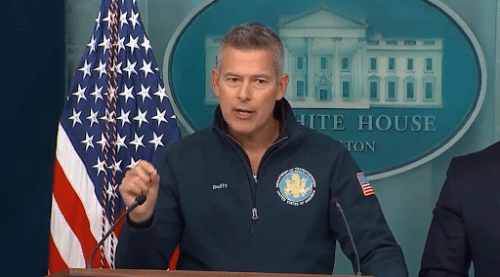
U.S. Transportation Secretary Sean Duffy and Homeland Security Secretary Markwayne Mullin provided updates on the incident during a news conference on Friday, emphasizing that the ground stop was issued as a precaution to protect passengers and aviation personnel.
According to Duffy, instability in radar and communications systems was first detected at approximately 3:36 p.m. E.T. at air traffic control facilities across the country, including Terminal Radar Approach Control (TRACON) facilities and En Route Centers.
The disruptions affected the consistency of radar data and communications between air traffic controllers and aircraft.
At the time, more than 3,500 aircraft were in the air. Controllers followed established safety procedures, allowing aircraft to land safely while the FAA halted additional departures.
Duffy said the number of aircraft remaining in U.S. airspace eventually dropped below 400 as flights were brought in safely.
“We have procedures for this. Our pilots are well trained. Our air traffic controllers are well trained. And we navigated it with our well-known procedures that we have when these incidents happen…We didn’t lose all telecom, we didn’t lose all radar, but that instability, because of abundance of caution and making sure we keep the American flyer safe, we did the ground stop,” said Duffy.
Although the FAA did not experience a complete loss of radar or telecommunications, officials determined that the system instability warranted a nationwide ground stop.
Flight delays expected to continue
Although the FAA lifted the ground stop Friday night, Duffy cautioned that normal flight operations would not resume immediately.
“Now, does that mean every flight is going to fly right now? It’s going to be slow. So, if you’re watching, you’re at an airport, check with your airline, said Duffy. “It depends on do we have crews available, do we have pilots and flight attendants available to fly your flight? We’re going to try to move as many of those as we can tonight if we have the capacity with crews to move those flights.”
Airlines faced the challenge of repositioning aircraft and ensuring pilots and flight attendants were available to operate scheduled flights.
He said it would take time for airlines to recover from the disruptions and return their operations to normal.
Outdated air traffic control equipment cited
Duffy attributed the technical problems to aging infrastructure within the nation’s air traffic control system, saying outdated telecommunications equipment and network hardware contributed to the instability.
He said the system still relies on older analog telecommunications technology, including equipment that struggled to handle the volume of data moving through its switches and routers.
According to Duffy, newer Internet Protocol switches installed as part of ongoing modernization efforts remained operational during Friday’s disruption. The problems involved older hardware that has yet to be replaced.
Duffy pointed to President Donald Trump’s push for a comprehensive modernization of the nation’s air traffic control infrastructure, saying previous administrations had failed to adequately address the system’s shortcomings.
He said approximately $15 billion had been allocated to FAA modernization efforts over the past 25 years, but argued that little progress had been made.
The Trump administration secured a $12.5 billion down payment for modernization through the One Big Beautiful Bill, according to Duffy. He added that the administration wants Congress to provide additional funding to complete the project.
Duffy urged lawmakers to support a bipartisan effort to replace the aging infrastructure rather than continue making incremental repairs.
FAA’s SMART technology not involved
Duffy also addressed questions about the FAA’s SMART tool, saying it had no connection to Friday’s communications and radar problems.
He described SMART as a decision-support system that provides airspace information and recommendations to air traffic personnel to help them navigate weather conditions and aircraft flight paths.
Human operators ultimately decide whether to accept or reject the system’s recommendations, he added.
Duffy emphasized that SMART operates separately from the equipment involved in Friday’s disruption and was not connected to the affected systems.
“This is not even plugged in,” Duffy said, dismissing suggestions that the technology contributed to the incident.
The FAA’s nationwide ground stop was an unusual measure, underscoring the importance of reliable communications and radar systems in maintaining the safety and efficiency of the nation’s airspace.